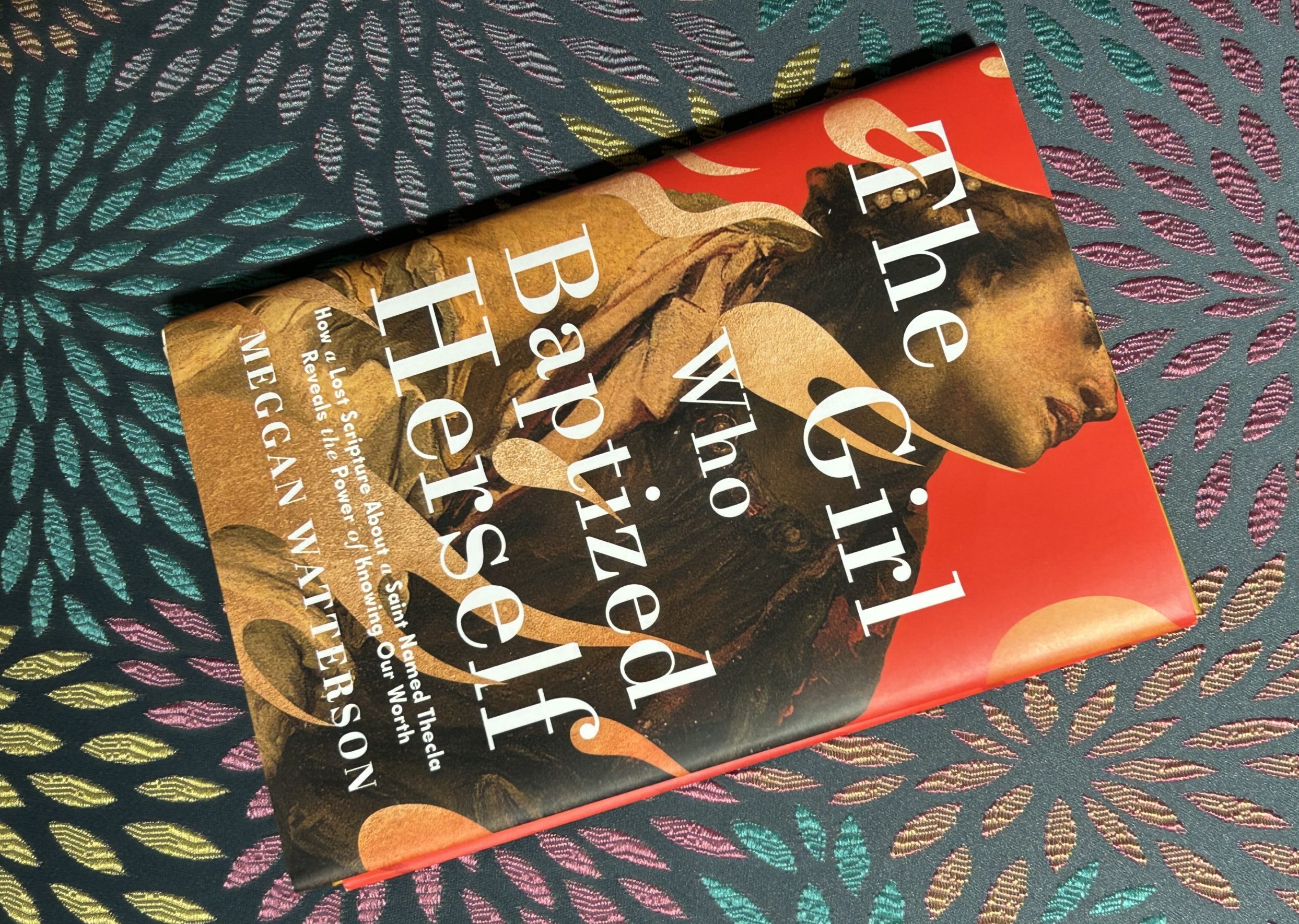
Too much church history can harm your faith — but once in a while somebody with a fresh and courageous voice sidesteps doctrinal conventions and pokes holes in ceilings to let the light back in. If you’re afraid to ask hard questions about the Bible — and, while you needn’t be a pewsitter to question — you should reject glib or authoritarian responses like “it’s a mystery” — maybe spending time with both books?
The author of this book, The Girl Who Baptized Herself, describes her own self as an “outsider” admitting she’s been called a “whore” a “witch” or worse. She’s got credentials as a scholar and she’s a good storyteller, unafraid to get naked and personal about difficult stuff. See Heb 4:13 NRSVu: “And before him no creature is hidden, but all are naked and laid bare to the eyes of the one to whom we must render an account.” ¿Ready to get naked? (Don’t be ashamed!)
.
Meggan Watterson has a Master of Theological Studies degree from Harvard Divinity School; and an M.Div from Columbia U, but has avoided ordination. She writes powerfully instead of preaching. She also speaks at various symposia, as detailed at her blogsite: MegganWatterson.com .
.
(I studied in the same graduate program as she, at Harvard, dropping out 20 years before she arrived; I still study the Bible most days, self-identifying as a Judeo-Christian heretic – as did Jesus – but his worship community executed him. He took punishment which could also have been mine, so I guess humanity has progressed somewhat from crucifying or burning such at the stake – for announcing that “the leadership is naked”.
..
Well, Meggan’s dynamic look at an ancient extra-biblical fragment, evidenced as early as first and second century, traces a story about a young woman listening to “St Paul” – earlier known as Saul of Tarsus, a strident religious hardliner – a Pharisee of the Temple cult of Jerusalem. (“Hit’em over the head with that scroll, Saul” – arrest those heretical “little christs”!)
.
The main character of the fragment is Thecla, a girl listening to Paul preach, in a life-changing event which has her refuse her family’s marriage arrangements. Big trouble! (No spoilers from me.) This radical rejection is recounted and interwoven throughout Meggan’s own story.
.
Both accounts remind me of a book by another Harvard author, Joseph Henrich, The WEIRDest People in the World, arguing that the reason the west has been economically successful is that westerners have rejected family dictators. But Meggan digs deeper into the past of this topic.
.
There’s so much to be digested in the stories of these two women, one ancient and one modern. I’ve made so many marginal notes in my copy that I don’t know where to begin. But new beginnings offer us all a fresh start, if we’ve got courage. They start with dying to self, which Paul advocates, saying “I die daily” (ICor15:31-b)— and presumably he is reborn daily, too. “Practice makes perfect.” ¿Are ya dead yet >>> “dead” to self; alive to the anointed One — your true Self, your Soul.
.
In the famous new-birth account between Jesus and Nicodemus, N asks if he must return to his mother’s womb to be reborn. J says no, you must be re-begotten. (There’s a phrase there about “water and spirit” which is crude street language rarely translated for publication or heard in churches: “spiritual sperm”. (We all detect nuance. Example: we overhear rough guys say, one to another” “did ya catch the melons on that babe?” — and immediately we know they are not discussing fruit or babies.) Jesus was not subtle! He knew his audience.
.
Well, it takes two to tangle, (double helix), and we might deduce that this is a joint project of our Father-Mother God which requires that we return to our current life — new-born, metaphorically-naked, without a vestige of our former egoic-selves, letting all of our acquaintances see us as complete, upright, whole, free, holy, healed — as ONE in-and -with God’s holy family — humanity’s community, “church” –ekklesia.
.
NOTE: For about 15 years I volunteered nearly every Saturday doing a nondenominational (Judeo-Christian) Bible study, a “stealth ethics course” really, at a men’s prison near Buffalo NY. I would often tell inmates to do the trade-in of a lifetime —by pushing your former junker-life onto the Dealer’s lot, coming away with a brand new ride. (But you can’t park your old life in an alley, or behind the barn, for weekend partying!) A few guys actually called me to say thanks after they got out. That classroom, and those inmates, taught me so much. We all need to come out of our cages! (We have a Patient Teacher!)

[Heard in silent gratitude, after reading an opinion piece by M.Gessen, NYTimes, 17 April 2026]
Gravity tugs alike on everyone. The sun shines on the just and the unjust. Rain falls on the wealthy and the weak.
Money inundates mindlessly, like water, seeking a path of least resistance. Bloodless corporations – “citizens” – cut deals into flesh, causing blood to flood and foul the globe.
“Sin crouches at the door.” Cain offers God a zucchini; then, in a fit of envy, he daily murders his brothers and sisters. And the bloodied ground cries out. [see Genesis 4 KJV]
Today, Divine Justice has prevailed in France, as chief executives, financial officers, and hacks are being sent to jail. And – as in heaven – so on earth – the promise of the rainbow*sparkles as truth – written in Light upon a dark cloud.
…LET JUSTICE ROLL DOWN…let justice flow like a river, and let righteousness flow like a never-ending stream. [Amos 5:24, NRSVu] ==============================================
Historians dislike the idea of prediction, but if we bring up the topic of tomorrow’s weather they will likely not object to consulting a forecast.
.
This author’s central thesis argues – see pages 23-25 of the hardcopy edition – that machines can now “predict” and fool humans, passing the “Turing Test” which was designed to detect the differences between human and machine replies to questions or instructions (think “Captcha” images). He asserts in this book that intelligence IS prediction, while asking elsewhere: “Is Life a Form of Computation?” (see MIT Press Reader, Sept 2025).
.
I’ve mostly avoided a study of A.I. during this developmental period, but I do think this book could be a landmark title, coming from a contrarian expert.
.
NEWS FLASH …Secretary of Defense, Pete Repeat, recently announced that DoD would break its contract with Anthropic, a leading A.I. developer, no longer allowing that firm’s Claude software to be used by US military, as Anthropic’s contract prohibits the use of its software to conduct mass surveillance of Americans. (The president agrees with Pete, and extends the ban to other portions of the federal government!) >>> Big Brother in jack boots! “Wandering police* ” — brutal, anonymous secret police behind masks!
.
* “Wandering police” defined: in 2024 the city of Hanceville Alabama fired its entire police force for being incompetent or corrupt, according to CNN.
Readers shopping for a favorite A.I. who also respect our Constitution (and contract law) would do well to choose Claude software, by Anthropic. (“None of us is as smart as all of us!”) If you’d like to read a real review of What is Intelligence? here’s one from an Australian scholar.
IN AMERICA, we have a First Amendment right to film in public. IN AMERICA, we are at war with a deep state sending armored MASKED goons, “secret police // aka “wandering cops” >>> into our cities to execute “observers”. IN AMERICA, “the land of the free, and the home of the brave” we will not let “them” execute us for being Americans! ~MeridaGOround // “Citizen-journalist”.
>>>EXCERPT, NYTimes: The nation’s founders worried that if the state had a monopoly on weapons, its citizens could be oppressed. Their answer was the Second Amendment. Now that our phones are the primary weapons of today’s information war, we should be as zealous about our right to bear phones as we are about our right to bear arms. To adopt the language of Second Amendment enthusiasts, perhaps the only thing that can eventually stop a bad guy with a gun is a good guy with a camera. More than 25 years ago, the science fiction writer David Brin foretold this exact crossroads. In his 1998 book “The Transparent Society,” he painted two alternate snapshots of a futuristic city festooned with tiny, ubiquitous cameras. In one scenario, the government uses the devices to monitor residents in an Orwellian police state. In the other, citizens can look at the live footage from any camera to watch out for one another and to keep tabs on the police, resulting in a just and fair society. The difference between oppression and liberation, he wrote, is, “Who will ultimately control the cameras?” Source: https://www.nytimes.com/2026/01/26/opinion/minnesota-minneapolis-phone-ice-shooting.html
LET’s THINK. Jesus was Jew-ish, sorta. He was from Galilee (in what then had been Israel, to the north of Judea), which was a long way on foot to where the Temple of Jerusalem was situated. There had been twelve tribes (“the children Israel” born of the patriarch, father Israel, meaning “God is in charge/God wins/God prevails”, who’s name had been changed from Jacob, meaning “he who overtakes” (his original name, for grabbing the ankle of his firstborn fraternal twin, Esau, trying to exit the womb, first, ahead of Esau)..
.
So, >>>fast forward>>> this large clan of twelve tribes fled slavery in Egypt where they had gone many years earlier, due to famine. But after many centuries the only tribe remaining was known as the tribe of Judah (thus the name: “Jew”-da), after one of Jacob/Israel’s sons, the fourth son of Jacob and Leah. History happens over time, rather than all at once. <wink>. .
.
Analogy: If my ancestors from Florida were born into the Seminole tribe, am I Seminole-ish, or am I Amerian-ish, or Euro-ish, after melding with the new neighbors? Yeah, there is some tension between ancestry, identity, citizenship, origin-story. (Hey, we all came out of Africa and of course, Egypt is in Africa, so Jesus and you and I are Africans!) So, was Jesus a Jew, or was he Jewish, or was he Galilean-ish, of the northern “state” of Israel, in the region also known as larger Palestine, where the various tribes of Jacob’s sons (and daughters) settled? The question “Who is a Jew?” shakes the earth yet today. Perhaps a weightier question “Am I a Christian?” is in order..
.
And maybe (or not) you bought a Christian “insurance policy” offering “salvation” — just in case — “sold by” Blaise Pascal, the father of probability math? “Better to have it and not need it, than to need it and not have it!”
.
OR, Do I even need a brand, or coverage? — “Am I a Christian?” – (a follower of “The Way”) because I admire and deeply desire to emulate the ethical teachings of Rabbi Jesus, of Nazareth — who said “the tree is known by its fruit”? What identifies me? Am I merely tribal, or am I endeavoring to practice the teachings of this Patient Teacher? Do I even have any fruit? .
.
This, my annual “Christmas greeting” was prompted by reading a book by a UCC pastor from Oklahoma, Dr.Rev. Robin Meyers, titled Saving Jesus from the Church. (You could take the free Kindle sample for a spin simply by clicking the Amazon link beneath their cover graphics.) .
.
Note: your Bible needs no energy beyond your own basic desire to think between the lines. Reading this way, skeptically, and listening, it becomes a fountain of wisdom! “Turn your radio on!” It’s got power, if you’ve got appetite.
Photo by S.Abbas Raza, editor/owner of 3QuarksDaily.com Fair use.
A famous Stoic philosopher named Epictetus was a slave as a child but grew up to become tutor to Emperor Marcus Aurelius. One of his students wrote down E’s teachings, (available for free, here)many of which dwelt on the observation that desire and aversion are two sides of the same coin. (Not his words, but conceptually still with us today: “No matter how thin we slice the baloney, it still has two sides.”) The so-called owner of the WhiteHouse Deli has his thumb on the scale, and is selling thin slices at top prices, which will cost America “bigly”. DOGE has demolished two centuries of carefully developed efficiency, saving nothing, but wasting huge amounts of global investment.
Apparently, nobody arrives on this planet with a round-trip ticket — or perhaps we all have one without knowing it? Yes, “End Times” could snuff life here in a grand ka-boom steming from various factors, perhaps in concert. (“Death” is a fellow traveler on this author’s train, and becomes an amusing companion.) The booktakes us on many train rides in pursuit of haunts of various philosophers, wryly questioning whether we’ve lived well, and learned anything while in life’s classroom. All aboard!
Pay attention, and you might find yourself enjoying the ride a bit more. I suggest taking the free Kindle sample for a spin. (If you don’t have a Kindle reader, you can download a free Kindle app for your laptop.) The author, Eric Weiner, is a former NPR correspondent, and world traveler. His author page includes another fun title, MAN SEEKS GOD.
This spiritual biography completes what other biographers have largely glossed. The author, a neuroscientist, has mounted a masterful effort at research, grasping Einstein’s thoughts along with various major thinkers across the ages, organizing “walk-ons” by Pythagorus, Socrates, Jesus, Shankara, Galileo, Bruno, Spinoza, Schopenhauer, et al. Einstein asserted that he was not an atheist, but rather, a student of “cosmic religion” – without hierarchy, dogma, or creed. There is something here for anyone with an open mind, a spiritual appetite, and deep curiosity about the Nature of reality. (This book pairs well with THE ONE: How an Ancient Idea Holds the Future of Physics, by Heinrich Päs.)
If I say CHECK, and you begin moving your King into an eternal dance, offering DRAW rather than conceding, you dishonor the game. You lost, but instead you replied “let us agree to disagree”. Boring! Any referee of a wrestling match would declare you PINNED, no matter how much you flop and wiggle your shoulders. (A few friends have replied that I’ve disrespected chess — neither my intent, nor my point.) The point is to quit distracting ourselves, instead focusing on real learning, as the book mentioned below argues for, compellingly.
SOCRATES thrived equally on refutation and being refuted. He loved them both; he was deeply interested in conjecture, inquiry and science (“true knowledge”) insisting that he knew nothing, but was deeply curious. He was identified by the Delphic Oracle, the spokeswoman for the god, Apollo, as the wisest man in Athens..
Agnes Callard, a philosophy professor at University of Chicago, has written a commentary on Sok’s life which is (mostly) thrilling to read. I’ve been reading philosophy books for many decades, ever since taking two courses in my final undergraduate semester, two of the best courses, ever. (Her book slows a bit in the middle, but press ahead, as there is gold in them thar hills!). Her book is one not to miss. (It’s very accessible, unlike so many philosophy texts written for other academic philosophers.) If you don’t already have a free Kindle App on your laptop, go to Amazon and download it, then read her free sample.