photo by MeridaGOround
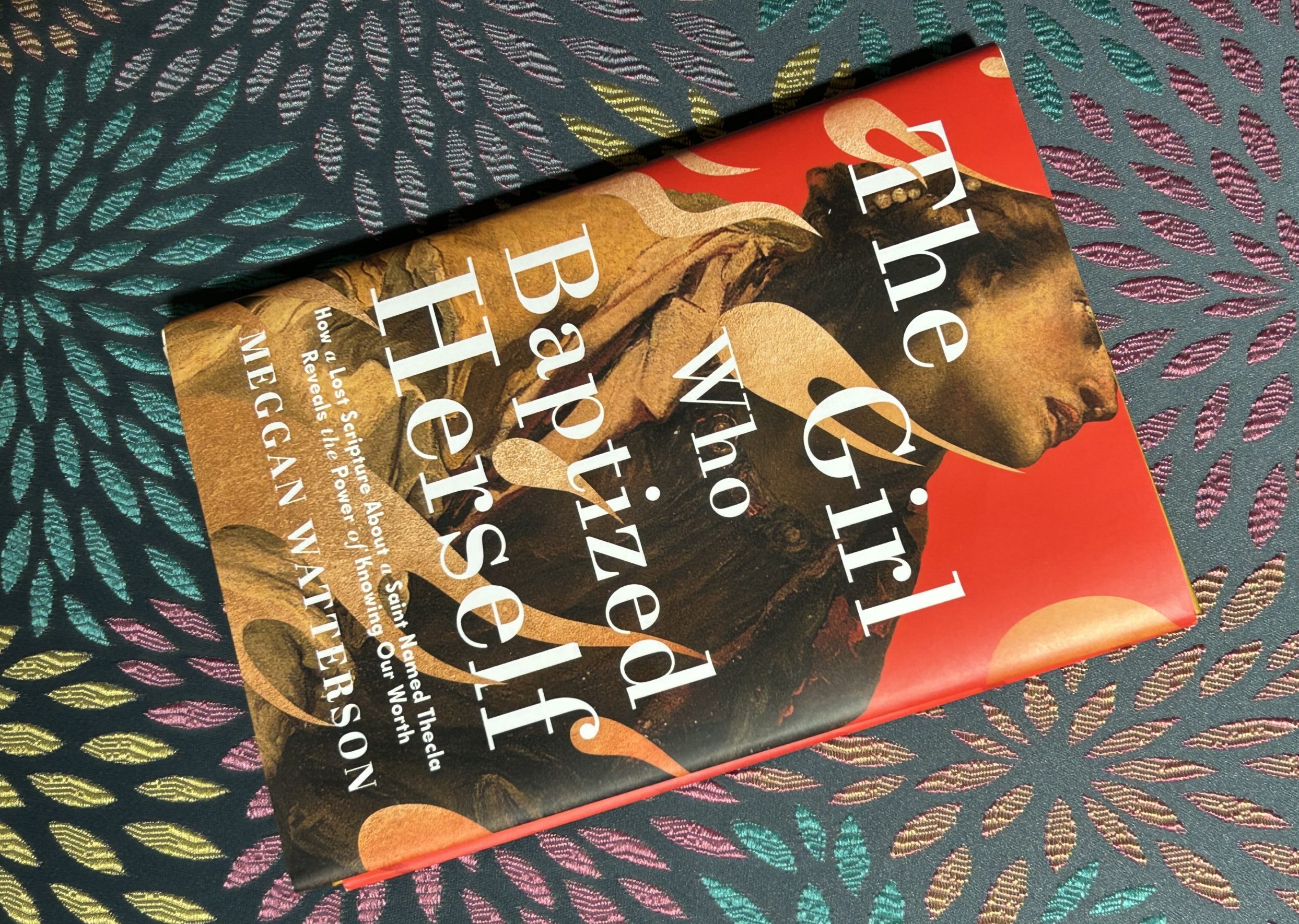
Reading too much church history might harm your faith — but once in a while somebody with a fresh and courageous voice sidesteps doctrinal conventions and pokes holes in ceilings to let the light back in. If you’re afraid to ask hard questions about the Bible — you needn’t be a pewsitter to question — and you should consider rejecting glib or authoritarian responses from anyone saying “it’s a mystery” — maybe spending time in thought with both books?
The author of this book, The Girl Who Baptized Herself, describes her own self as an “outsider” admitting she’s been called a “whore” a “witch” or worse. She’s got credentials as a scholar and she’s a good storyteller, unafraid to get naked and personal about difficult stuff. [See Heb 4:13 NRSVu]: “And before him no creature is hidden, but all are naked and laid bare to the eyes of the one to whom we must render an account.” ¿Ready to get naked? (Don’t be ashamed!)
.
Meggan Watterson has a Master of Theological Studies degree from Harvard Divinity School; and an M.Div from Columbia U, but has avoided ordination. She writes powerfully instead of preaching. She also speaks at various symposia, as detailed at her blogsite: MegganWatterson.com .
.
I studied in the same graduate program as she, at Harvard, dropping out 20 years before she arrived; I still study the Bible most days, self-identifying as a Judeo-Christian heretic – as did Jesus – but his worship community executed him. He took punishment which could also have been mine. I guess humanity has progressed somewhat from crucifying or burning such at the stake, for announcing that “the leadership is naked”.
..
Well, Meggan’s dynamic look at an ancient extra-biblical fragment, evidenced as early as first and second centuries, traces a story about a young woman listening to “St Paul” – earlier known as Saul of Tarsus, a strident religious hardliner – a Pharisee of the Temple cult of Jerusalem. (“Hit’em over the head with that scroll, Saul” – arrest those heretical “little christs”!)
.
The main character of the fragment is Thecla, a girl listening to Paul preach, in a life-changing event which has her refuse her family’s marriage arrangements. Big trouble! (No spoilers from me.) But get my hint that myth can be truer than history; and canonical gospels can be sacred myths, while extra-biblical gospels should not be utterly dismissed. Radical rejection is recounted and interwoven throughout Meggan’s own story and scholarship. Hey, Jesus said that we must receive the kingdom of God as a little child (see Mark 10:15).
.
Both accounts, Thecla and Meggan, remind me of a book by another Harvard author, Joseph Henrich, The WEIRDest People in the World, arguing that the reason the west has been economically successful is that westerners have rejected family dictators. But Meggan digs deeper into the past of this topic.
.
There’s so much to be digested in the stories of these two women, one ancient and one modern. I’ve made so many marginal notes in my copy that I don’t know where to begin. But new beginnings offer us all a fresh start, if we’ve got courage. They start with dying to self, which Paul advocates, saying “I die daily” (ICor15:31-b) — and presumably he is reborn daily, too. “Practice makes perfect.” ¿Are ya dead yet >>> “dead” to self; alive to the anointed One? — your true Self, your Soul.
.
In the famous new-birth account between Jesus and Nicodemus, N asks if he must return to his mother’s womb to be reborn. J says no, you must be re-begotten. (There’s a phrase there about “water and spirit” which is crude street-language rarely translated for publication or heard in churches: “spiritual sperm”. (We all detect nuance.) Example: we overhear rough guys saying, one to another” “did ya catch the melons on that babe?” — and immediately we know they are not discussing fruit or babies. Jesus was not subtle! He knew his audience.
.
Well, it takes two to tangle, (double helix), and we might deduce that this is a joint project of our Father-Mother God which requires after rebirth that we return to our current life — new-born, metaphorically-naked, without a vestige of our former egoic-selves, letting all of our acquaintances see us as complete, upright, whole, free, holy, healed — as ONE in-and -with God’s holy family — humanity’s community, “church” –ekklesia.
.
NOTE: For about 15 years I volunteered nearly every Saturday doing a nondenominational (Judeo-Christian) Bible study, a “stealth ethics course” really, at a men’s prison near Buffalo NY. I would often tell inmates to do the trade-in of a lifetime —by pushing your former junker-life onto the Dealer’s lot, coming away with a brand new ride. (But you can’t park your old life in an alley, or behind the barn, for weekend partying!) A few guys actually called me to say thanks after they got out. That classroom, and those inmates, taught me so much. We all need to come out of our cages! (We have a Patient Teacher!)

photo by MeridaGOround